The Fort Dodge Messenger: March 23, 1906
(Editor’s note: This is an extremely long article. It took nearly six full columns in the original paper and was difficult to type. It is likely that there are errors in the text which were unintentional. I grouped the question and answer portion of the coroner’s inquest in order to make it easier to read. I will also include the March 24, 1906, funeral notice for Walter Cutting here, instead of in a separate post.)
No One Held For The Accident
Coroner’s Jury does Not Blame any One for Death of Walter Cutting.
Verdict Gives Causes Only
Interesting Testimony Comes Out When Coroner’s Jury Has Session – Most Valuable Testimony That of Brown and Todd.
■ ■ ■
Jury’s Verdict.
An inquisition holden (sic) at Fort Dodge In Webster County, Iowa on the 22nd day of March A.D. 1906, before A.H. McCreight, coroner of said county upon the body of W.E. Cutting, there lying dead, by the jurors whose names are hereto subscribed; the said jurors upon their oaths, do say that W.E. Cutting came to his death at 4:00 a.m. March 22, 1906, in Duncombe, Webster County, Iowa, death being caused by dislocation of his neck at a result of failing or jumping from engine No. 1005 on the I.C.R.R.
In testimony whereof the said jurors have hereunto set their hands the day and year aforesaid.
James D. Lowry
L.A.Thorson
W.W. Haire
Coroners Jury.
Attest:
A.H. McCreight
Coroner.
■ ■ ■
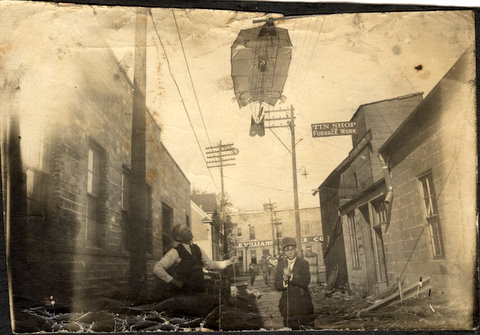
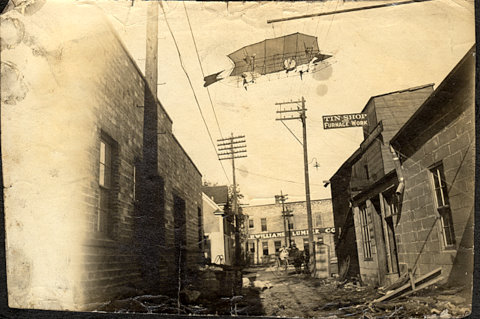
The coroner’s jury which was impaneled Thursday morning, spent Thursday afternoon at the scene of the wreck, and held its meeting for the examination of witnesses in the evening. At the evening session most interesting, and most valuable testimony was taken. As will be noticed in the above verdict no blame it laid against the company or any man.
The crews of both trains were all examined, and their testimony was all in harmony, to one who heard the entire testimony it would be hard to place the blame on any one in particular. Every man seems to have done his best to prevent the wreck, and the latter was caused by a combination of circumstances, which were not to be foreseen.
The testimony of Engineer Brown, the first engineer on the lead train naturally was the most valuable with the exception of that of Brakeman Todd, the flagman for the freight train. Their testimony is given in full below, and is well worth reading, as it brings out many points, that are a mystery to the average person.
Train Can’t Stop Quickly.
It will be noticed that brown gives out that he thinks the flagman was 400 feet above the passenger depot, or about 1,500 or 1,600 feet from the switch. In Todd’s testimony the latter says he was as far above the depot as the switch was below it, which would make him over 2,000 feet from the scene of the wreck.
Either distance to the non railroad man, would seem ample space in which to stop a train, however C.A. Bryant, who is well versed in such matters says that the record for stopping a train going at that speed is over 1,400 feet. This train which was a test train by the Westinghouse Air Brake Company only consisted of five cars and one engine, thus being half the tonnage of No. 1. The Central train then could hardly be expected to stop within less than 2,000 feet when running at a speed of from sixty-five to seventy miles an hour.
Second Crews Statements
The testimony of Engineer Stark the second engineer on this train was like that of engineer Brown, with the exception that he did not see the danger signal, but merely shut off his engine after Brown whistled him. He then cut in on the air to see if Brown’s air was working right and finding that it was, let the first engineer continue to apply the air. Then after sanding the track, and reversing the engine he jumped. The testimony of his fireman Mr. Wood was also of like nature.
Dispatchers Testimony
The testimony of conductor McCarthy with his baggageman and brakeman was as to the speed the train was running, and of the proceedings after the accident. The testimony of Dispatcher J.E. Elkins was also taken, and he testified as to the correctness of the orders he had given the trains, namely that No. 1 was to run 49 minutes late. He did not make the meeting order for the two trains, as the freight crews are supposed to make their own meeting place with first class trains, after the dispatcher has given them the time on the train.
The testimony of conductor McNamara of the freight train was that, he received orders like those mentioned by Mr. Elkins and that he thought his train would have plenty of time to make Duncombe. The testimony of Engineer Smith of this train was that he agreed with conductor McNamara and worked under the latter. He said that in the darkness he ran by the switch about two car lengths and that to stop the train he forced the air on hard. The air stuck then, and he had to waste two minutes pumping it up again. the freight was also a heavy one consisting of twenty-four loads and ten empties and he had to take up the slack three times in entering the siding. This all took time and is what caused his train not to get in the clear.
Headlight Seen.
The testimony of Fireman Eccelston of the freight was like that of Engineer Stark. He agreed with him concerning the time, and also about the air working hard, and the train pulling up the grade onto the switch hard. He told of giving Todd the fuses and torpedoes, and how he saw No. 1’s headlight, as Brakeman Todd left the switch.
Brakeman Brennen, the rear brake man on the freight testified that he thought as did every member of the crew that they had plenty of time to reach Duncombe in safety, had not things been against them. When asked where he was when the train struck he made the first remark which caused, even a smile, for he answered “In a cornfield.” He said that he went forward to the switch, but that when he saw the passenger was going to strike them, he ran as far and as fast as he could. When asked how far he said until he struck a fence and got caught in it.
Officials Careful.
Every employe (sic) testified that the road was most careful in handling its trains. Their orders were first to look out for the safety of employes and the passengers. Next they should endeavor to get over the road as quickly as possible, but safety first. When asked if the officials ever countenanced the man taking chances, every man answered positively in the negative.
The drift of the men’s statements was that in railroading every man takes certain chances, and that if things go well all is well, but that if things go wrong all is wrong. they all seemed to agree that fate was against them on the fatal night.
Cutting’s Death a Sad One.
The body of the deceased man was taken to his home in Waterloo on No. 2 that evening leaving fort Dodge at 9:40 P.M. It is not known here as to whether or not the funeral will occur at Waterloo or at Iowa Falls, the home of his parents.
Cutting leaves a father and mother, several brothers an sister, besides his wife and three weeks old baby. His family is a railroad family in every sense of the word, for all of his brothers and his father are employed on the Rock Island.
The day preceding this death had been a happy one to the deceased man and as he jumped to his fate, his thoughts were of others. He told Engineer Brown repeatedly on the trip off how happy he was, for it was the first day his wife had been able to sit up in weeks. She had been up with him all evening, until the time he was called to bring out his last run. Even as he stood on the step, ready to jump, he called to Brown, “What will become of the fellows behind., they can’t see the freight.” then he leaped outward and was followed by Brown.
Cutting was popular with all his fellow employes. He was a man of excellent physical proportions, and was light hearted and friendly with all.
“Walt” he was to all of them and as they repeat the name, they check back a sob. Engineer Brown who was with him on the fated engine seems to be nearly frantic. He paces up and down constantly, talks about the accident, but but does not seem to control his nerves. He says that while he was partially conscious soon after the accident, he did not realize the awfulness of it for an hour, and then it came back to him. He said jumping was the only thing that saved any of them. He said that his body could have been sent home by mail had he stuck tot he engine.
He had not jumped when the engine struck, but was ready to do so, and was throw (sic) far out from the rails.
Engineer Brown who was in the head engine on the passenger train was perhaps the more important witness at the inquest. His testimony was as given below:
O.M. Brown, being first duly sworn by the Coroner, testifies, as follows:
Direct Examination.
The Coroner:
Q. What is your name?
A. O.M. Brown
Q. Residence?
A. Waterloo.
Q. Occupation?
A. Locomotive engineer.
Q. How long employed?
A. Nineteen years.
Q. Where were you on March 21st and 2nd?
A. On train No. 1 coming west from Waterloo.
Q. What time did you leave Waterloo?
A. 1:50.
Q. How much later is that than usual time of the train?
A. Forty-five minutes.
Q. Did you receive any orders after you left Waterloo?
A. No sir.
Q. What were the orders received at Waterloo?
A. Run forty minutes late.
Q. How near did you come to obeying that order?
A. I was just forty minutes when I stopped at Webster City, when we got out of there were just three minutes later, makes it forty-three minutes.
Q. What time did you get into Duncombe, if you know?
A. Four o’clock.
Q. What if anything did you do when you approached near Duncombe. Which engine were you one?
A. The lead engine.
Q. Who was firing for you?
A. Mr. Cutting.
Q. And as you approached Duncombe, you whistled at the whistling post?
A. Yes sir.
Q. How far east of the station is the whistling post?
A. About a mile, I should judge.
Q. What next attracted your attention?
A. A red light.
Q. Where was this red light?
A. East of the depot.
Q. How far east of the depot, as near as you can tell?
A. Four or five hundred feet, I couldn’t tell exactly.
Q. Four or five hundred feet east of the station house you saw a red light?
A. Yes sir.
Q. Being swung across the track?
A. Yes sir.
Q. You immediately recognized that, as what?
A. Danger signal.
Q. What did you do?
A. Reached up to answer the signal, the signal is two short blasts of whistle, and my hand slipped off the whistle lever as I whistler (sic), as soon as I reached. I threw the air into emergency.
Q. What is the number of your engine?
A. One thousand and five.
Q. What about its weight, as compared with other engines?
A. Heavier than the average engine.
Q. What is true with reference to reversing those engines?
A. What is what?
Q. What is true with reference to reversing those engines, making them back up?
A. I can make them back up, yes sir.
Q. Can you do it suddenly when you are going at a high rate of speed?
A. Yes sir.
Q. Was it done in this case?
A. No sir.
Q. Would it have been safe to do it?
A. It might have stripped the engine.
Q. Would it have helped any to stop the train?
A. Oh it might and it might not. If the engine slipped, it wouldn’t have done as much good.
Q. That is what I want to know, if you did everything that was safe to do or wise to do?
A. I done everything to stop the train.
Q. Safe to do or wise to do?
A. Yes sir.
Q. How far west of the station house was it before you came to the freight train?
A. I should judge one thousand feet or a little over, I know know the exact distance.
Q. At what rate of speed were you gong when you saw the danger signal, as near as you can tell?
A. About fifty-five or sixty miles an hour.
Q. What rate of speed did you immediately assume?
A. Twelve miles an hour.
Q. Did you strike the freight train?
A. Yes sir.
Q. With your engine?
A. Yes, sir.
Q. On which side of your engine was this freight?
A. On the north side right on the near side, on my side.
Q. How near were you to this freight train before you saw the obstruction on the track?
A. I don’t know exactly how far it was.
Q. What were you instructions to the fireman when you saw there was an obstruction?
A. I cautioned him to look out.
Q. What did you both do?
A. Both jumped off.
Q. From the same side?
A. Yes sir.
Q. Same side of the engine?
A. Yes sir.
Q. On which side of the engine did you jump?
A. On the south side.
Q. You crossed over then to the fireman’s side?
A. Fireman.
Q. And after he jumped what did you do?
A. I stayed on until the last second and then I jumped.
Q. How far did the engine move after you left it.
A. I can’t tell you.
Q. The length of the engine?
A. I couldn’t tell you, just as I jumped I struck the train.
Q. Were you hurt?
A. Oh, scratched up and little bruised.
Q. Were you able to gain your feet immediately?
A. No, sir.
Q. Have you any idea of the lapse of time before you did get up and walk?
A. No, sir.
Q. What did you do when you got up?
A. I don’t remember what I did do.
Q. Did you begin looking to see how much damage was done, or looking for the other boys?
A. No, sir, not immediately, the first I remember, I was in the coach sitting on a mail sack. I don’t know how I got there or who put me there.
Coroner: The jury any questions?
Mr. Thorson:
Q. In how short a distance would it have been possible to stop that train, could it have been possible to stop it between three hundred or four hundred feet east of the station and the time it struck the other?
A. No sir, not at the rate of speed it was going.
Coroner:
Q. You state the rate of speed – with the heavy train that you had with two engines, what would be the shortest distance to stop?
A. I don’t know. I never was brought down to a test of that kind.
Q. How far would you say to estimate?
A. If I was getting into a town and was going to make a stop at the town I would commence braking a half a mile from the station, slow the train down gradually, may be a little sooner, if it was down hill, commence making brakes sooner.
Mr. Thorson:
Q. Did you state the distance from where the collision took place how far that was west of the depot?
A. About one thousand feet.
Coroner: Any other question?
Haire:
Q. How fast do you think the train was going when you struck?
A. About twelve miles an hour.
(Signed) O.M. Brown
Witness excused.
Flagman W.C. Todd of the freight crew, a witness produced at the inquest being first duly sworn by the Coroner, testified, as follows:
Direct Examination.
Coroner:
Q. State your name, age and resident?
A. W.C. Todd, thirty-three, Fort Dodge
Q. Occupation.
A. Brakeman.
Q. Were you engaged in the occupation of brakeman on the morning of March 22nd?
A. yes, sir.
(no question printed here)
A. Conductor McNamara
Q. What capacity?
A. As head brakeman.
Q. What time did you leave Fort Dodge?
A. 3:05, I believe.
Q. How many loaded on your train?
A. Twenty-four.
Q. And empties?
A. Ten
Q. What were your orders, with reference to No. 1?
A. We had order, “No. 1 engine unknown, would run forty minutes late Waterloo to Fort Dodge.”
Q. What were your duties, as crew, with reference to meeting passenger train? How much time are you to give passenger trains?
A. We are to clear passenger trains ten minutes.
Q. This is the only order that you had with reference to No. 1?
A. yes, sir.
Q. Were you supposed at any and every point that you reached to determine whether or not you could give that train ten minutes at the next siding before leaving that point?
A. Yes, sir.
Q. Where were you riding?
A. On the engine.
Q. Did you make any stops between Fort Dodge and Duncombe?
A. No, sir.
Q. There were no stops?
A. No, sir.
Q. Were there any signals from the conductor or rear brakeman, from the time you left Fort Dodge?
A. Not on my side of the train, I don’t know of any.
Q. You don’t know of any?
A. No, sir.
Q. When you reached Duncombe did you note the time?
A. Yes, sir.
Q. What time was it?
A. 3:45.
Q. Well if No. 1 was forty minutes late, what time would No. 1 reach Duncombe?
A. That would put them out of Duncombe at 3:53.
Q. They are not supposed to stop there?
A. No, sir.
Q. And they are practically arriving and leaving at the same time?
A. Yes, sir.
Q. Did you leave the engine to open the switch?
A. Yes, sir.
Q. How long did it take to get the engine reversed and backed up?
A. May be about two minutes.
Q. How far beyond the switch did the engine go before it stopped?
A. Nearly two car lengths.
Q. It took two minutes to release the air and back up?
A. Yes, sir.
Q. Then you opened the switch?
A. Yes, sir.
Q. Then the engineer attempted to start the train?
A. yes, sir.
Q. In order to carry you in on the siding?
A. Yes, sir.
Q. Did he have any difficulty in starting the train?
A. Yes, the train started very hard.
Q. Did he have to clack?
A. Yes, sir.
Q. In order to get it started?
A. Yes, sir.
Q. How long did you stand at the switch watching him attempt to start it?
A. Just as quick as I threw that switch I started up to flag.
Q. As soon as the switch was thrown you started to flag?
A. Yes, sir.
Q. Did you walk?
A. No, sir, I ran.
Q. Did you get as far as the station house?
A. Yes, further than the station house.
Q. How much further?
A. Went east of the passing track.
Q. How far east of the station house was that?
A. I don’t know exactly, it must be about thirty car lengths.
Q. What length is a car?
A. About forty feet.
Q. Then, you would estimate it was twelve hundred feet.
A. About that.
Q. That is what it would figure out?
A. Yes, sir.
Q. You think you were twelve hundred feet east of the station house?
A. Well, I don’t know it was that many feet because I don’t know the length of them but I was by the passing track switch.
Q. How far from the station house?
A. About the same distance.
Q. You were about as far from the station as the switch you train was trying to make was west of the station?
A. Yes, I was about as far east of the station as our train was west of the station.
Q. What did you have with you?
A. I had a fuze and torpedo.
Q. I wish you would explain what a fuze is?
A. That is a kind of an explosive we light, that will burn a certain number of minutes, about ten.
Q. Making a red light?
Q. yes, sir.
Q. What is a torpedo?
A. Sort of a dynamite cap.
Q. Explosive?
A. Yes, sir, makes a loud noise.
Q. The torpedo is fastened to the track.
A. We fasten it to the track.
Q. And what else?
A. White light.
Q. A flag?
A. No, sir.
Q. What did you do with your torpedo?
A. Placed it on the rail, as the passing track switch.
Q. What did you do with the fuse?
A. I lit the fuse.
Q. With a match or lantern?
A. It has sulphur (sic) on the end I struck it and had quite a little time getting it to light. I saw it wasn’t going to work very good and it went out.
Q. It didn’t work well?
A. No, sir.
A. I grabbed the switch light, which I intended to do all the way up there, because I didn’t have a red light with me. I intended to use that switch light. I thought I could make that switch in plenty of time.
Q. You grabbed the switch light –
A. Off the switch stand.
Q. And swung it across the track?
A. Yes, sir.
Q. How far east of you was train No. 1, at that time?
A. I couldn’t tell in the dark, I don’t know whether they whistled for town east of the whistle post or west of it. I was giving them stop signs before they whistled for town, and after they whistled for town, he answered my signal.
Q. He answered your signal after he whistled for town?
A. Yes, sir.
Q. After getting the answer to your signal and knowing that the engineer had received your signal, what did you do?
A. Just for an instance I stopped my signals to him to let him understand it was recognized, then I started with my signals again, as hard as I could swing them.
Q. Waved the lantern frantically?
A. Yes, sir, both lanterns, white and red.
Q. How long was it after that before the engine passed you?
A. I kept waving the lights until they passed me.
Q. How long between the time the engineer answered your signal until the engine reached you?
A. I couldn’t say.
Q. How long did it seem a minute or two minutes?
A. I couldn’t estimate how long it was.
Q. Do you have an idea how far away the train was wehn you first attempted to signal?
A. I think they must have been out there by the whistling post. I thing (sic) that is about a mile.
Q. You had run as far as you felt it was necessary to run, it would have been useless to go any further.
(no answer printed)
Q. You signaled them as vigorously as you could?
Yes sir.
Q. How long after you began signaling them until you were answered?
A. From the time I started to signal them, I must have been in all ten car lengths running.
Q. Did you swing the lantern at that time?
A. yes, sir.
Q. This was the lantern that you had gotten from the switch, east of the station house?
A. Yes, sir.
Q. You didn’t take the lantern from the switch you first came to?
A. No, sir.
Q. You ran signaling for ten car lengths before the engineer answered?
A. yes, sir, then I stopped for a few seconds.
Mr. B.J. Homey:
Q. You say when you stopped there, you were thirteen minutes to the good, and then it took two minutes to back up?
A. Yes, sir.
Q. And then you started at once to go to flag the train, did you?
A. Yes, sir, that is just what I stated.
Q. Was that your duty, if you had plenty of time to get in the good?
A. Why, it is always my duty to flag if it is necessary.
Q. Did you know at that time it was necessary?
A. Yes, sir.
Q. What was the reason that you knew at the time you threw the switch that it was necessary?
A. I knew we couldn’t get on from the position we were in. I knew we couldn’t get in and clear in ten minutes, and that it was necessary to flag them.
Q. You had thirteen minutes then, – that would be 11 minutes you had to flag them, and you started at once to flag, as soon as you threw the switch?
A. Yes, sir.
The Coroner:
I think we will leave that in testimony.
Dr. Lowry:
Q. Did you look at your watch when you started easst to flag?
A. Yes, sir.
Q. Was there more than eleven minutes when you started east to flag?
A. I think that is what I had.
The Coroner:
Q. You occupied probably nine minutes of that in running?
A. Well I couldn’t say as to that. I didn’t keep time.
Q. I was trying to make up my mind how far you could run in nine minutes.
Dr. Lowry:
Q. How fast do you think the train was going when they passed you, the passenger train?
A. I think they was going about fifty miles an hour, fifty or sixty miles an hour, something about that.
The Coroner:
Q. Do you think if the fuses had worked all right, it would have made any difference, wouldn’t the engineer have been just as likely to see the red lantern you had as he would the fuses?
A. Yes, I think he would.
Mr. Thorson:
Q. Could you tell from where you were when they applied the air?
A. No, sir.
The Coroner:
Q. You couldn’t tell from the sound of the incoming train?
A. No, sir.
Q. Could you, if they had been near you, is there a noise made by the train when they apply the air, that you could recognize?
A. No, sir.
Q. They were too far at the time they applied the air for you to tell that?
A. I couldn’t say as to that.
Q. It is your opinion that the air was applied at once as soon as they answered your signal?
A. That is ruleable.
Q. Could you tell any difference from the speed of the train from the time they answered your signal until they passed you?
A. No.
Q. Would that be due to the fact that the train was going so fast, it would not begin to manifest any difference in speed?
A. I couldn’t tell how fast they were going back there a half a mile.
Q. They were going at a good speed?
A. Yes, sir.
Q. They were not running faster than they were ordinarily supposed to run?
A. They were not ahead of time.
Q. They hadn’t made up any time?
A. Not as I know.
Dr. Lowry:
Q. Where were you when you first noticed the headlight of the coming train?
A. I was between the depot and the north track of the switch, the passing track.
The Coroner:
Q. So far as east and west is concerned, you were about up to the depot?
A. I was east of the depot.
Q. You had passed the depot? (this line is repeated)
A. Yes, sir.
Q. Before you saw the headlight?
A. Yes, sir.
Dr. Lowry:
Q. How far can you see a switch light?
A. On a clear night I have seen them for four miles.
Q. Shat signal did you give them, the stopping signal?
A. Yes, sir.
Q. All the time?
A. Yes, sir.
(Signed) M.C. Todd
■ ■ ■
The Fort Dodge Messenger: March 24, 1906
Cutting Funeral Sunday
Illinois Central Wreck Victim Will be Buried at Iowa Falls That Day.
Waterloo Reporter: Funeral services of the late Walter E. Cutting will be held Sunday afternoon at 2:00 o’clock from the Baptist Church in Iowa Falls. Reverend Hargraves will officiate. Illinois Central Officials have generously offered the use of a special passenger train that will leave this city at 11:20 o’clock Sunday morning, and a large delegation of Masons and members of the Brotherhood of Locomotive Firemen will attend the rites.
Walter E. Cutting is survived by a widow and one child and other relatives as follows: Mr. and Mrs. Ellis Cutting (parents) father is an engineer on the Rock Island; and brothers Henry, an engineer in Washington state; George an engineer in Colorado; William, an engineer on the Great Western with headquarters at Kansas City, and Arthur, a brakeman on the Rock Island with headquarters in Cedar Rapids. Two sisters, Bessie and Sadie, live with the parents at Iowa Falls; another sister is married and resides in northwestern Iowa, and a fourth sister is Mrs. Varink, whose husband is a Cedar Rapids engineer.
■ ■ ■
More information on Walter E. Cutting:
According to my search on www.familysearch.org, he was born in 1879 and married on Nov. 30, 1904 to May Pearl Boddy (born 1880) in Hardin County. Walter’s parents were Ellis Cutting and Bessie Glenny Cutting. May’s parents were Edward Boddy and Jane Green Boddy.
I base my information on the marriage date and Walter’s father was mentioned in the funeral notice. In the 1900 census, there are four children in the household: Walter, Sadie, Charles and Bessie. The census says that Ellis was born in England and Jane was born in Ireland. They lived in Iowa Falls, Iowa, at the time of the census. It also says that Walter was born in July 1880, which contradicts the marriage information.
Tags: 1906, Brown, Cutting, Haire, Homey, McCreight, Todd