Archive for the ‘Inventions’ Category

14
Jan

Fort Dodger Invents

   Posted by: admin Tags: , ,

The Fort Dodge Messenger: Jan. 14, 1907

Fort Dodger Invents

Ernest Green Has Automatic Equipment to Close Switches

Ernest Green, a former Fort Dodge young man, is the inventor of a railroad device that promises to come into general use on all traffic lines. It is believed that no little fame is in store for its inventor. Regarding a test of the appliance recently made the Buffalo Express has the following:

“Ernest Green’s device for automatically closing an open switch before an oncoming train was recently tested with great success on the Lake Shore at Silver Creek where Mr. Green lives.

“Freight locomotive No. 5830 was used in the tests and was run over the portion of the track equipped at speeds that varied from 25 to 55 miles an hour. Roadmaster Connors and other officials who witness the test say the device worked perfectly and promptly.

“It appears to be a very simple and inexpensive equipment. It makes it possible for a train to take an open switch. A switch left open carelessly or by design closes automatically in front of the train.”

16
Jul

Give Scientific Demonstrations

   Posted by: admin Tags: ,

The Fort Dodge Messenger: July 16, 1904

Give Scientific Demonstrations

Professor Patty Will Make Interesting Experiments at the Chautauqua.

Wonderful Radium Properties

Is an Inexhautible (sic) Source of Heat and Energy – One Stick of It Can Propel a Steamship Across the Ocean – The Experiments.

On July 26 at the Fort Dodge Chautauqua Professor Patty will demonstrate in a lecture some of the properties of the latest scientific discoveries, namely, radium liquid air and wireless telegraphy. Professor Patty is the possessor of a small piece of radium about the size of a pea. The value of radium at present is about $1,000,000 per pound, and yet is it contained in small quantities in almost every other substance like air, water and earth.

The process of reducing it from these substances is yet in the primary experimental state. The most remarkable qualities of radium are its inexhaustible energy of heat and light. The scientists have held a theory called the conservation of energy, namely, that the give and take energy from one body to another is generally believed to balance up. and now radium is discovered to give a continuous expenditure of energy without receiving any equivalent. The source of its power seems to be entirely unlimited. In radium we have a dynamo which throws off high-power electricity whitout any engine or machinery to enforce it. Our steamships could cross the ocean by using the energy of a stick of radium and we understand that that the Light and Power company are negotiating with Professor Patty for the loan of his piece of radium to furnish power to run the street cars with during the Chautauqua if the long delayed shaft don’t come before that time.

These wonderful properties of radium give a new meaning to the relation between spirit and matter so that this new discovery is likely to have an influence on the logical thought. Radium also has some healing qualities and will effect the study of medicin.

All of its wonderful properties are to be demonstrated by Professor Patty in a way to please and instruct the large audience that will no doubt gather on the occasion. He will also show the remarkable properties of liquid air which melts steel pens and freezes strawberries to 312 degrees below zero. A small amount of it will heat a house in winter and cool it in summer.

But the most practical of all recent scientific discoveries is wireless telegraphy. Professor Patty will also demonstrate this. He has a compete set of wireless telegraph instruments and will send and receive messages thru space in t he presence of the audience.

Wireless telegraphy has already become a necessity to this world for it is the only way whereby ships can at a distance communicate with one another and with the shore. Navies of all nations are being rapidly equipped and its possibilities in warfare are being tested in the present conflict between Japan and Russia.

We shall expect soon to have telephoning made possible by the wireless system. The exhibition of these scientific experiments with radium, liquid air and wireless telegraphy will provide a rare opportunity to the people of the community of gaining first hand and accurate ideas of scientific phenomena of world wide renown and the greatest importance.

(Editor’s note: For more about radium, visit this Wikipedia article. For one thing, the article states: “The amounts produced were aways relative small. For example in 1918 13.6 g of radium were produced in the United states.” That amount converts to less than half an ounce – .4797 ounce, to be precise. The $1 million dollar price for a pound of radium would be about$23,949,480 today. Also, it would be easier to search online for Professor Patty if the article had mentioned his first name I did find one specific mention of him in the Chautauqua magazine, mentioning that he would be at the Chautauqua in Fort Dodge in July 1904.)
1
May

For All Trades

   Posted by: admin Tags: , , , , ,

The Fort Dodge Messenger: May 1, 1905

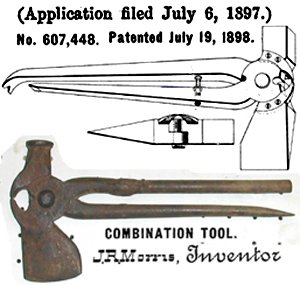
Tool to be sold by National Hatchet Company

This illustration provided courtesy of Directory of American Tool and Machinery Patents website.

For All Trades

Webster City Company Will Build Ingenious Tool.

Webster City, May 1 – Articles of incorporation for a new manufacturing company in this city have been signed. The organization is to be known as the National Hatchet company and will manufacture a patent tool which can be put to many uses. The officers of the organization are:

E.E. Valentine, Webster City, president; W.A. Norton, Marshalltown, vice president; G.A. Smith, Laurel, secretary; H.R. Dodge, Webster City, treasurer; J.R. Morris, Jewell, Kan., manager.

The company is capitalized at $50,000. The tool they will manufacture can be used as a hatchet, hammer, wire cutter, leather punch, nail puller, screw driver and has detachable jaws upon it. With a change of jaws the tool adds the following to its many uses: A hoof trimmer, pruning knife, bailing applier, stock marker, pipe wrench and some others.

(Editor’s note: I found a website with an illustration of the tool. It is posted with permission of the Directory of American Tool and Machinery Patents and Stan Schulz, DATAMP “Wrench steward”  & editor, Missouri Valley Wrench Club newsletter. You can visit this page for more information. )

20
Apr

To Build a Shock Loader

   Posted by: admin Tags:

The Fort Dodge Messenger: April 20, 1904

To Build a Shock Loader

De Loura Auto Manufacturing co. to Construct One.

The Machine Will Be Sent South and Worked North With the Harvest.

J.J. Ford, secretary of the Iowa Shockloader company, has let the contract for the making of patterns and the construction of a shockloader after the plans of the late patent, to the De Loura Automobile Manufacturing company of this city, and the machine (at least one line of text missing here – something like: will be sent down south.) From Oklahoma, as the small grain ripens, it will be worked north to Minnesota, the Dakotas, and even perhaps into Canada. It is also the intention of the company to have a sufficient number of the machines manufactured by some concern, not yet decided upon, to supply this year’s trade, and wherever the model machine is displayed orders will be taken, which the company will be able to fill at once.

It is expected that by showing the work of the machine in this practical manner, and over such a wide territory a great demand will be created for it at once, and that next year’s trade will be greatly accelerated by  the proceedings of the machine and knowing it is a success, will not be afraid to take it. It is felt by the patentees that in the way of simplicity, quality of work, durability and light draft, the present model cannot be much improved. The machine has been put at actual work int he field, and all the difficulties that then appeared have been remedied.

25
Mar

Fort Dodge Man Invents Air Craft

   Posted by: admin Tags: ,

The Fort Dodge Messenger: March 25, 1912

Fort Dodge Man Invents Air Craft

C.C. Merrill Has Completed Model for New Monoplane – Has Applied for Patent on Invention

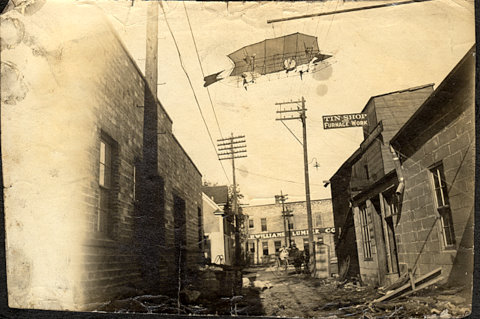
Monoplane invented by C.C. Merrill, of Fort Dodge

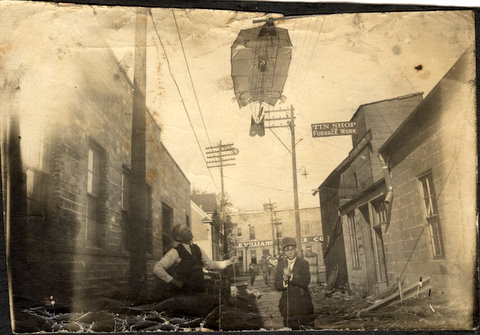
Monoplane invented by C.C. Merrill, of Fort Dodge. This alley is between 11th and 12th streets, north of Central Avenue. Current location is behind Daniel Pharmacy. Photo courtesy of Webster County Historical Society.

C.C. Merrill, a well known farmer, living south of the city, is the inventor of an airship, which he is confident will be a success. He has completed a working model, which he has on display at the Black & Kirkpatrick garage, on Central avenue. The machine is a monoplane, and has several new features never used before on a craft of this character.

One of the principal features is the use of four propellers, two placed on either side of the frame, one pair at the front of the machine and the other at the rear. By the use of four propellers, instead of two as commonly used, Mr. Merrill claims that his machine will be able to make a much quicker ascension and that the descent can be made in a perpendicular line instead of the gliding style as now practiced by all aviators.

Another distinctive feature in the new model is the arrangement of all weight in such a manner as to entirely eliminate the possibility of the craft overturning. This is accomplished by hanging all weight well below the plane in the manner of a gigantic parachute.

Mr. Merrill was formerly associated with H.B. Weld, one of the best known air craft men in the country and president of the recent aviation meet held in Chicago. While in .Chicago, Mr. Merrill conceived the idea of making a monoplane, and this winter during his spare time has constructed a model of what he believes will be one of the most practicable machines ever built.

Monoplane invented by C.C. Merrill, of Fort Dodge. Photo courtesy of Webster County Historical Society.

Photos and article courtesy Webster County Historical Society