23
Mar

Measles at Orphans’ Home

   Posted by: admin   in Disease, Medical matters, Quarantine

The Fort Dodge Messenger: March 23, 1904

Measles at Orphans’ Home

An Epidemic of the Malady Exists There.

The Disease Has Been Exceptionally Severe – Pneumonia a Frequent Complication.

An epidemic of measles in a most violent form has broken out among the babies at the German Lutheran Orphans’ home on Sixth avenue north, and one of the little ones lies at death’s door with complications resulting from the disease.

The malady appeared at the home some time ago, and at the present time every baby in the institution is seriously ill with the complaint. The disease has been exceptionally severe, and in every case has left the little on a victim to some complication or other. Pneumonia is the most common of these complications, while in some of the children, diseases of the middle ear are the after effects.

In the case of the child  which is at present in the worst condition, and which will undoubtedly die, the measles first became complicated with pneumonia, and later, in spite of all that medical science and the best of care could do, farther complications set in and the child has meningitis in addition to measles and pneumonia.

The disease as it has appeared at the home is said to be the most violent nature possible to the malady, being the worst that has appeared in the city for some years. There is, however, no danger of a spread of the disease, as the home is kept thoroughly isolated by quarantine.

Tags: , ,

23
Mar

Yes Easter is Near at Hand

   Posted by: admin   in Holidays

The Fort Dodge Messenger: March 23, 1907

Yes Easter is Near at Hand

A Glance at the Easter Novelties in Store windows Will Tell You.

Easter Teddy Bear is Newest

He Make Take the Place of the Easter Rabbit in Time – Easter Eggs, Candies, Postcards and All Other Kinds of Novelties.

A stroll down Central Avenue and a look into the store windows will tell you that Easter is near at hand even if you had no way of reckoning it by the calendar.

It is not alone the displays of fancy toggery and O! trite expression, “the Easter Bonnet,” that tells the story. The appearance of the windows of the novelty stores fairly shout it into your ear.

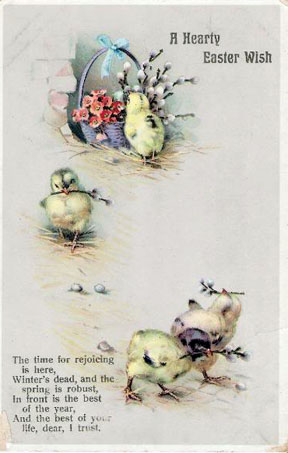
Easter postcard

Easter Postcard The poem reads: A Hearty Easter Wish The time for rejoicing is here, Winter's dead, and the spring is robust, In front is the best time of the year, And the best of your life,dear, I trust.

Novelties newer and neater, more varied and heterogeneous in the nature of the displays have never been seen in Fort Dodge. Of course the old time Easter Rabbit, the friend of the children, takes greatest prominence, but he bids fair to be displaced by the newer “Easter Teddy Bear.” The Teddy Bear is a pusher but the latest example of his goatlike propensities is his getting into the Easter novelty crowd. the easter Teddy Bear is a little fellow, fuzzy and comical and but little larger than the Easter rabbit. He sits in a nest of eggs or holds one in his clumsy, wobbly arms.

Hens sitting on nests of eggs, soft downy little chickens and ducks that look wonderfully like the real thing, beautifully colored artificial Easter eggs and the rabbit in dozens of sizes and hundreds of poses are on the list.


The most popular pose of the rabbit is where he is seen, like a chick just emerging from the shell of a big white egg. He is shown in several states of the process of getting out of the shell.

All kinds of creations in candy goods are to be seen, too. hens, chickens and ducklings, candy eggs, chocolate Bunnies make up the list. Egg dyes which are warranted to color the barnyard fruit of Mistress Cackle any desired hues are advertised.

Easter postcards are in interesting lot too. Sentimental ones are somewhat in evidence but the artistic kind prevail. Easter lillies, pictures of Easter choirs and many cute and quaint verses may be found on the cards that are set out everywhere.

Tags: , , ,

23
Mar

Geo. A. Griswold of Manson Murdered by Highwaymen

   Posted by: admin   in Crime, People

The Fort Dodge Messenger: March 23, 1903

Geo. A. Griswold of Manson Murdered by Highwaymen

Was a Passenger on Electric Car Between Los Angeles and Santa Monica California – Shot While Concealing His Watch and Died in His Mother’s Arms

George A. Griswold, son of the late H.J. Griswold of Manson, heir to the large Griswold estate, and a young man well and favorably known to many Fort Dodge people, was shot down by hold-up men in a street car in Los Angeles on Saturday night. His mother and his aunt, Miss Anna Funk of Manson, with whom he was riding, were spattered with his blood.

The body will be brought to Manson for burial, but the time of the funeral has not yet been decided upon.

H.J. Griswold, father of the murdered man, was one of the most prominent citizens of Manson. George was an only son. His death leaves his mother alone in the world.

Mrs. Griswold, and her son, and Miss Funk were spending the winter in California, in accordance with their regular custom. They were expected to return to Manson in a short time.

George A. Griswold was prominent in Manson and was very popular. Mr. Griswold was a member of the Fort Dodge Chapter and Commandery of Masons. If his body is buried in Los Angeles, the rooms of the order will be draped in mourning. If the funeral occurs in Manson, it is probable the Fort Dodge Masons will have charge of the exercises.

Los Angeles, Cal. March 23 – Three masked robbers attempted to hold up a car on the Los Angeles-Pacific electric line, running between Los Angeles and Santa Monica, about a mile west of the city limits, and after a pistol duel between C.W. Henderson, one of the passengers, and one of the robbers, the other two highwaymen began shooting right and left through the crowded car. One passenger was killed and three wounded.

The dead: G.A. Griswold, Manson, Ia.

The wounded: J.C. Cunningham of Los Angeles shot through the left thigh, serious; Ellis Pearson, shot through the left leg; Dr. C.H. Bowles, shot through the left hand.

It is believed that one of the robbers was badly wounded. Mr. Griswold was a wealthy citizen of Manson, Ia. He came here several months ago for the  benefit of his mother’s health.

The hold-up occurred at the head of a deep cut. The robbers had placed a steel rail, a large bench and a cement barrel on the track. The motorman saw the obstruction when the car was several hundred yards from it and at once turned off the current and ran slowly to the place. The moment the car struck three men, wearing masks over their faces, sprang from the weeds alongside the track. One boarded the front end of the car and the other two the rear end. The first man commanded the passengers occupying the open seats to put up their hands, and when one of them did not comply, he fired a shot. Henderson then opened fire on the robber, shooting as fast as he could pull the trigger. The robber turned his gun upon Henderson, but as he did so he was seen to bend over and cry out as if in pain. Then straightening up, he began shooting at the passengers huddled int he front seats. One of his bullets struck Ellis Pearson in the left leg. Henderson continued firing and the robber was seen to fall.

While this was going on on the outside of the car a tragedy was being enacted inside. The two robbers who had entered the rear door commanded the passengers to raise their hands, and most of them did so. Before any attempt could be made by the robbers to search teh passengers for their valuables, the shooting began on the outside of the car. Then the other two robbers began shooting right and left into the crowd of passengers. At the command, “hands up,” he tried to secrete his watch under his legs, and one of the robbers, thinking he was about to draw a gun, fired point blank at him. The bullet struck him in the back of the neck, and he fell over into the lap of his aged mother, who was seated at his side.

Dr. C.H. Bowles was near the front door and at the command of the robbers he raised his hands. When he had them in the air one of the bullets from a robber’s revolver struck his left hand and shattered the bones. After emptying their revolvers the robber backed out of the door and sprang off the car and disappeared.

That many more were not killed or wounded is little short of miraculous. Inside the car was thirty or more passengers and there were more than ten shots fired. Bullets were found imbedded (sic) in the woodwork in many places when the car reached this city.

Griswold expired before the car had gone a mile. He never spoke after he was shot and when his body was lifted from the car at Santa Monica his watch was found under him on the seat. His mother was covered with his blood and was almost insane from fright and grief. The bullet which killed him grazed the cheek of Miss Anna Funk, who was traveling with him. The highwaymen secured nothing whatever from the passengers.

Tags: , , , , , ,

The Fort Dodge Messenger: March 22, 1906
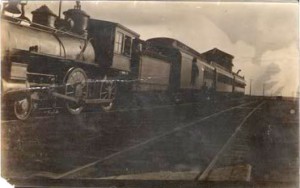
This photo shows a train with passenger cars.

I.C. Limited in Collision; Fireman Cutting is Dead

Fast Passenger Train From Chicago Ran Into a Freight Train.

Disaster Occurs at Duncombe

Freight Train was Pulling into a Siding to Clear Main Line.

Freight Struck in Middle

Passenger Train Had Double-Header – First Locomotive Reduced to Scrap Iron – Fireman Cutting Jumped and Had Neck Broken.

The Dead.

Fireman Walter E. Cutting, of Waterloo. Neck broken.

The Injured.

Engineer O.M. Brown, of Waterloo. Cuts and bruises, not serious.

Engineer Ed Stark, of Waterloo. Back injured, cut and bruised. Will live.

fireman W. Wood, of Waterloo. Face badly cut. Not serious.

Place.

West switch at Duncombe. About 800 feet from depot.

Trains.

Limited passenger train No. 1 west bound with double header. In charge conductor McCarthy of this city, and Engineers Brown and Stark, of Waterloo. East bound freight extra, in charge of Conductor McNamara and Engineer H.A. Smith, both of Waterloo.

Damage Done.

Engien No. 1005, large passenger locomotive, stripped of all parts. Will have to be entirely rebuilt. Five freight cars entirely destroyed. Small section of track torn up.

Trains Delayed.

No. 1 delayed over six hours. No. 6 delayed about two hours. All freights held until wreck is picked up.

The second serious accident on this division of the Illinois Central occurred at 4:00 o’clock this morning, when the crack limited train No. 1, west bound, struck an east-bound freight extra as the latter train was being pulled onto a siding at Dunccombe. Fireman Walter Cutting, of Waterloo, lost his life in the wreck, while Engineer O.M.  Brown, Engineer Ed. Stark and Fireman W. Wood all of Waterloo received more or less serious injuries.  The huge one hundred ton locomotive is dismantled, its parts being thrown for a hundred feet from the scene of the crash, while several fregiht cars were ground into small pieces, which would not make a decent sized piece of firewood.

The cause of the fatal accident is not yet determined. The crews of the two trains tell somewhat different stories, and as yet the officials seem to believe that the cause was improper flagging. Every employe (sic) concerned in the wreck has been in the service for years, and an examination of each man’s record shows it to be almost faultless.

A Messenger representative boarded the first trrain that left Fort Dodge, after the accident became known, and arrived at the scene, before the work of picking up the wreck had commenced. The injured men and the deceased firemen had already been taken to Fort Dodge, but the scene was yet decidedly gruesome.

A curious throng numbering as high as five hundred people gathered around the scene of the accident. Time and time again the crowd had to be shoved back in order to give the men space to work.

The first relief train pulled out of  the Fort Dodge station about 6 .m., and had on board the company physician with a corps of assistants, and also the company officials. Within twenty minutes more a wrecking train with crew followed this train out. The first train was composed of baggage car wtih coaches, to transfer the passengers, but on arrival it was seen that the4 train could be brought through intact by waiting a few hours.

No. 1, the passenger train that was wrecked is the limited train of this road. It consisted of a mail, express, three sleepers, and two chair cars at the time of the accident. The train was somewhat late out of Waterloo this morning, and two engines were couples on to help make up time. The regular engine, No. 1005, was the lead engine, and was followed by a small engine, No. 916.

The passenger train was bout an hour late out of the eastern terminus of this division, and the dispatcher gave them running orders of forty minutes. Engineer O.M. Brown, or as he is more commonly known “Windy Brown,” is known as a fast runner, while engineer Fawcett, the man in charge of the No. 916, is a man who can handle an engine well.

Both men are from the freight service, although Engineer Brown is first extra passenger man, and spends over half of hi time in the passenger service. The two men were whipping their long train along in superb style, until the Duncombe station was reached, when a flagman signaled them to go carefully.

With a train running close to seventy miles an hours (sic), it is a hard matter to stop wtihin 1000 feet, but the two men shut off the steam, according to report, and Engineer Brown applied the air. The distance was too short and the big engines struck the freight train midways, as it was pulling onto the siding.

Four Enginemen Jumped.

After applying the air all of the four enginemen jumped, but not successfully. It seems that Walter E. Cutting the fireman on the head engine picked a poor place, for he struck on a log spanning the ditch at the side of the track. His neck was broken, and death must have been instantanous (sic).

Engineer Brown was badly cut about the face and body, but is able to move around. Engineer Fawcett on the second engine injured his back in the jump and was somewhat badly hurt. fireman Wood on the second engine struck on his face, which is badly cut.

The big 1005 is one of the 1600 class locomotives used on the fast passenger runs. It weighs about 135 tons, and is of the Atlantic type. The big engine rolled over on its side, the side underneath being the left of the side of the cab occupied by the fireman. The entire engine appears to be dismantled, the ponty truck wheels, being found about fifteen feet ahead of the engine body.

The big axles, which are about eight inches in diameter were bent and twisted as though they had been small wires. The wheels were torn and dented. The big boiler head is dented and cracked. The cylinders are torn and twisted, while even the driver wheels are dented. The shafts are broken, and warped, while the mechanism seemed to be ripped entirely from the engine.

The engine cab is filled with a mass of wreckage, and it would have been instant death for one of the men to have stayed within it.

The tender of the engine was also badly damaged, the wheels being torn off. The second engine escaped with scarcly any damage. The front end was crushed in to a certain extent, but the engine steamed into Fort Dodge, without aid.

Passengers Uninjured.

The two big engines acted as a buffer for th epassenger coaches and escaped any damage.

The passengers in the sleeper were not even all awakened, while those in the chair cars wre badly shaken out of their seats. the express messenger, baggagemen and mail clerks all received severe jolts, but none wre injured.

The big passenger locomotive fell to the south side of the track, while the fregiht equipment was thrown for hundreds of feet along the north side. Four freight cars loaded with oats were totally demolished, while a flat car was ruined.

Two of the four freight cars were the first struck were so badly damaged that it would be hard to find a piece of either big enough to use as stove wood.

One other car seems to have suffered nearly as bad as the largest piece of it visible is a section of the roofing about ten feet long. the fourth box car is broken in two in the middle, and ruined. The car is to be found about 100 yards up the track, broken in two in the center.

In this accident it would have been impossible to tell how many cars were ruined were it not for the car trucks, and even some of these are so badly damaged that it would be hard to tell what purpose they served.

The grain is piled along the track for about one hundred feet; and in some places is four or six feet high. Railroad officials on the scene say that the cars will all be burned.

Master Mechanic Talks.

Master Mechanic R.W. Bell was one of the officials to accompany the steam wrecking outfit from Waterloo. When seen by a messenger representative he said that he estimated the damage at a little over $2,000. When surprise was expressed at this low sum, he stated that the iron apparatus on the cars, which are always the most expensive can be used over again. the engine while stripped of its fixtures, can be rebuilt for a comparatively low sum. The estimated cost of rebuilding it should not go much over $1,000 according to this official.

Mr. Bell expressed great sorrow at the death of Cutting. He said Mr. Cutting was a regular engineer who was working as fireman during the period of slack work. He has always been regarded as a most competent employe (sic) and is a man of excellent habits. He leaves a wife and small child.

Mr. Bell said Mr. Brown was also regarded as a very competent engineer and that the crew on the second locomotive were worthy men. He said that the company had been most fortunate in not having serious accidents and that an accident of this kind consequently caused more notice than it would on other roads where accidents were more frequent.

The Cause.

There are numerous stories of the cause of the accident and for anyone to sift out which is the correct one is almost impossible, until the official investigation is completed. Superintendent Jones was in Omaha at the time of the accident and did not arrive at the scene until afternoon today. He will return here this afternoon or evening and the investigation will be made.

The story that seems to be universally accepted is that the freight train stopped west of the switch, while the brakeman threw the switch for the siding. The train was an exceedingly heavy one, and the air stuck, which caused a delay of several minutes in getting it started. This train was in charge of conductor McNamara and Engineer H.A. Smith of Waterloo.

Before the train had gone onto the siding, No. 1’s headlight was seen in the distance, and a flagman hurried down the track to flag this train. Before he could get far enough down the tack, the grain met No. 1. He flagged the train, but the distance was too short and the heavy train could not be stopped quick enough to save an accident.

Another Theory.

Another story was that the No. 1 had made up more time than the dispatchers order allowed, and when the train arrived at Duncombe, it was ahead of its schedule, and thus caught the men partially unprepared. Thsi latter part seems to be believed by several of the men, but the officials deny it.

the Fort Dodge wrecking crew with the smaller derrick were not needed after the big steam derrick from Waterloo arrived. The local men returned here shortly after noon, but the Waterloo outfit will probably remain on the scene until Friday evening at the earliest.

The big engine tender was first pulled away from the engine. It was then swung away, and will be taken to Wa- (its schedule, and thus caught the) terloo on flat cars. The big engine will be repaired, somewhat and will then be hauled to Waterloo. The big drive wheels will be able to carry the engine in, if slow time is made.

The freight equipment wrecked will all be burned. The contents of the cars will also probably be burned, and the scrap iron will be carried into the shops where it can be used again.

The Men’s Injuries.

Engineer Brown in speaking of the accident said that he saw the flagman about four hundred feet from the switch, and that the train was running about sixty-five miles an hour. he said that he applied the emergency and whistled for brakes. then he jumped to the left and remembered nothing more until he came to an a corn field about fifty or seventy-five feet from the track. His head is somewhat badly cut, while the muscles on his back and neck are sore and bruised.

Edwin C. Stark, the engineer on the second train said that they were running about sixty-five miles an hour when he heard Brown whistle for brakes. He reversed his engine and jumped. His left ankle was sprained, his knee was cut and he was injured about the hip and back. His injuries are not serious, but will probably lay him up for several days.

Royal G. Wood, the fireman on the second train stated the speed was about sixty to sixty-five miles an hour. He saw Stark jump from his side of the cab and followed him out. His face was badly cut.

The men in talking over the affair seem to believe that the whole affair was caused by the flagman being too close to his train, as the limited could not stop within four hundred feet under any possible circumstance when running close to a mile a minute. All were grieved over Cutting’s death, and one said, “I don’t care what happens to me know, I am so glad to be alive.” They say that when they picked Cutting up, his face was in water, which had escaped from the tender. Had he only been stunned he would have been drowned, as he had been there several moments when found. Had any man stayed in the 1005, he would have been killed, as the steam and boiling water was thrown all about the cab and for some distance around it.

Coroner McCreight impanelled (sic) a jury and after viewing the remains of Cutting, the jury went to Duncombe. This afternoon was spent in going over the scene of the accident, and viewing the wrecked engine and cars. The jury examined the train and engine before leaving, and will complete its investigations at the Court House this evening.

On the Coroner’s jury, besides Dr. McCreight the coroner, were Will Haire, Dr. Lowry and Louis Thorson.

Tags: , , , , , , ,

21
Mar

Chickens Will Be Scarce

   Posted by: admin   in Animals, Farm life

The Fort Dodge Messenger: March 21, 1904

Chickens Will Be Scarce

Supply Not Recovered From Past Wet Seasons.

Comparatively Few birds and Unusually High Price May Be Expected This Spring.

Chickens and in fact all kinds of farm fowls are unusually scarce this spring and the prices promise to be higher than in years. Old fowls to be used for stock purposes, are bringing from five to seven dollars, just double the usual price, and are scarce at that. Early spring friers this year promise to bring unprecedented prices, and a good henery will be a real “oil well” investment to the farmer who is lucky enough to own one.

The past two wet seasons are accounted responsible for the scarcity of the birds. It is well understood that wet weather is exceedingly hard on the young chickens and lucky, indeed, was the spring chick that pulled thru last year.

Thousands of chickens were drowned outright in the big rains of last spring, or died from the exposure of being dragged about thru the wet grass by a most inconsiderate mother. For these and a number of other reasons, there were few chickens raised last year, as compared to the ordinary season, and the surplus over the spring market was light. This year about all the chickens there are left in this part of the state are those left over from two years.

This scarcity of the old bird, with the intense cold of the past winter, also accounts for the scarcity and high price of eggs during the winter, and there will probably be some dearth of eggs felt until this year’s birds are large enough to lay.

Tags:

21
Mar

Two Canine Robinson Crusoes

   Posted by: admin   in Animals, People

The Fort Dodge Messenger: March 21, 1903

Two Canine Robinson Crusoes

Fine Gordon Setters, Marooned on Duck Island Were Rescued on Friday

Animals Were Almost Starved

Supposed That They Had Been Left There Since Going Out of Ice 10 Days Ago

If it were part of a canine’s education to read Robinson Crusoe, two fine Gordon Setter dogs might consider their positino during the past ten days as similar to that of this famous adventurer.

On Thursday, some of the workmen employed on the Great Western elevator noticed two wolfish looking dogs skulking around Duck Island. The dogs appeared to be in desperate circumstances as they had evidently been imprisoned on the island since the ice went out, which was about ten days ago, and were afraid to brave the deep icy water which lay between them and the shore.

H.J. Bryson and Otto Foster, who are employed at the elevator were moved with pity at the sight of the poor beasts, who were howling with hunger and cold and a boat was procured and the dogs rescued. Mr. Bryson says the dogs were as “tickled as a seven-year old child on Christmas Day,” and were as grateful to their rescuers as human beings in like circumstances. After appeasing their appetites the freed prisoners scampered off not being anxious to remain in the vicinity of their bondage. It is not known who is the owner of the dogs. It is thought that the animals, which are valuable ones were tempted onto the island in pursuit of rabbit, on other game and the ice going out left them in a rather unenviable position. Judging from t heir actions the dogs must have been on the island for ten days or more.

Tags: , ,

21
Mar

He Forgot to Stay Away

   Posted by: admin   in Crime, People, Police court

The Fort Dodge Messenger: March 21, 1904

He Forgot to Stay Away

Nutty Willey Returns and Gets into Trouble.

Steals a Coat and is Bound Over to the Grand Jury on the Charge of Larceny.

Ernest Willey, the “Nutty” Willey of police court fame, will probably give the city authorities little trouble for some time to come. Willey was ordered out of the city Friday morning and promised to do so and never return. He left town, but forgot to stay away. worse than that when he did return Saturday night he went into the Haire clothing store and when he left forgot to pay for a coat which he had carelessly picked up.

When arrested he was given no further chances to depart from the city, but was taken before a justice of the peace and bound over to the grand jury charged with larceny. It is probable that the jury will report on Willey’s case tomorrow, and a disposal made of the charge against him at the present term of court.

Tags: ,

20
Mar

Town Topics

   Posted by: admin   in Seasons, Spring, Town Topics

The Fort Dodge Messenger: March 20, 1907

Town Topics

Today is in every way an ideal Spring day. The opening of Spring to a country boy means many things. It means that he will soon be fishing under the banks of the Des Moines for suckers. It means that he will sprout potatoes on the barn floor, or get the little onions ready for planting on the back lot.

The prospect of a productive season is a change even from the slush and ice of a long and dreary winter. The farmer goes out to see whether the bees are getting ready to swarm; the town man prepares to plant some flower seeds on the front lawn. The housewife, the whole land over, looks up the mops and brooms and gets in readiness for the Spring housecleaning.

Everything takes a new start, as it were, in life; we begin anew and feel brighter and better natured and feel glad that we are living.

And now that Spring seems to have run up the curtain in readiness to open the show there are many things which while we enjoy nature and its changing forms, the town dweller should attend to. Nature will do her part to beautify Fort Dodge, but it will not remove the accumulations of ashes and refuse in the cellars of our citizens. It will not repair bad pavements, muddy street, stopped up gutters or sinking crossing stones.

Nature will cause flowers to grow in the country wood, but not on the citizens lawn unless seed be planted. Nature will make the shade trees burst into leaf but it will not remove unsightly wires, broken limbs or dead trees from the streets.

The sun will shine brightly on pretty dwellings and business places, but it will not apply the paint or the whitewash brush to the back fence or the front shutters where the wintry storms have caused a former application to wear off.

Nature will make the parks look green and beautiful, but the corner lots will still have an unsightly appearance unless man assists in “clearing up.”

Nature will asist (sic) in Spring housecleaning, but as this has been a very strenuous winter, there is much for the average citizen to do to make Fort Dodge look more beautiful than ever before.

Tags:

20
Mar

Told in Knierim

   Posted by: admin   in Animals, Knierim

The Fort Dodge Messenger: March 20, 1907

Told in Knierim.

Something That Explains The Scarcity of Ducks This Spring.

“Yessir. Killed a thousand ducks. Why they wuz so plentiful that year that my brother and another feller killed a thousand in one day.” The oldest inhabitant took a long draw at his pipe as he looked out of the corner of his eye to see how the story was received.

“Aw, that’s nothin’,” was the quick reply from a young man who had perched himself on the counter. “Why, ducks was so thick one spring that Paw killed them with a pitchfork when they flew past the wagon over his head.”

As an explanation of the scarcity of birds this spring and their shy manner, the above stories were told in a store at Knierim a couple of days ago.

20
Mar

Annual Argument on Hats Arrives

   Posted by: admin   in Fashion

The Fort Dodge Messenger: March 20, 1905

Annual Argument on Hats Arrives

Spring Season opens and Spring Hats Must Soon Be Bought.

The Cost is Evenly Divided

Styles in Women’s Hats are Rapidly Conforming with Those Practiced by Men’s Hatters and the Tailored Hat is the Proper Thing.

A season of the year is soon to delight the feminine part of Fort Dodge although it may counteract its effects by the reception it receives among the opposite sex, and the coming season is that of the spring openings in the numerous millinery stores of the city.

Then it is that the annual joke maker will begin to please one sex with the annual jokes about big hats and if he runs out of jokes about the big hats, he will make some up about enormous prices on small ones, so that it is easily to be seen he is hard to satisfy.

In reality if everyone will be honest, they will admit that all the fuss about high priced hats is concocted just for the convenience of the joke man and that although a woman does sometimes spend a good price for a hat she either wears it several seasons or does not have any other during that season.

Times are fast changing and styles in hats are advancing as rapidly as they are in other lines. The tailored hat a few years ago was unknown in the realm of bonnetdom, and no woman now is properly dressed for the street or for church unless she wears one, and any other style in the above named places would be as incongruous as a man wearing an opera hat to his business.

In the average walks of life a man pays nothing less than five dollars for his every day hat and if statistics were obtained it would be found that the women who pay more than that for their street hats are balanced on the other side by the man who pays more than five for his.

Then a man generally buys a straw hat of greater or less price for summer wear, and that corresponds to the dress hat that a woman buys for the garden party, and the evening party or reception and even should the masculine readers of this article contend that the woman’s hat costs more, he must remember that she can take off the plumes and other trimmings and put them away to help out with next year’s hat, and that a man’s hat, once discarded, leaves no trimmings for next years.

When you advance into the more prosperous and wealthy circles prices and numbers of hats, in both masculine and feminine wardrobes, or perhaps it should be wardhats, will increase proportionately.

As we said in the beginning, the spring season is soon to open, the usual creations will be shown and the usual woman will go home with the usual bonnet which she has decided upon after looking longingly at the more expensive one which fit her taste but not her purse, and in the usual way she will try to convince herself that the one she got is much more becoming and appropriate after all.

And just because she can monage (sic) to get a few more pretty trimmings on her hat than the man can on his, pray do not let him get the idea that is it more expensive.

■ ■ ■

With the closing of this story, it is to a certainty, decided that there can never be any more spring jokes about spring hats, and of course everyone is convinced that the writer is surely a man, and therefore would be fair and honest to give the opposite sex such a gallant service in this much abused argument.

(Editor’s note: One thing I miss about articles in this time period is that there are no bylines. We have no idea who wrote what, and even no record of who the reporters were at this time. I’m inclined to this that this piece was written by a woman, or at least a man with a very close connection (wife, sisters or mother) to the feminine side. The argument for comparing prices and features of hats, with the notion that a woman’s hat has decorations that can be used again, leads me to think that a woman thought it up. I could be wrong, and there is no way to check.)